CROSS-BORDER PAYMENTS
Cross-border payments have long been the slowest, most expensive corner of global finance — routed through chains of correspondent banks, taking days to settle, and losing value to fees at every hop. UPI is now being tested against that exact problem.
The early results are striking on one specific metric: growth. Cross-border UPI transactions grew more than twentyfold in a single year, from roughly 37,000 in FY24 to over 755,000 in FY25.
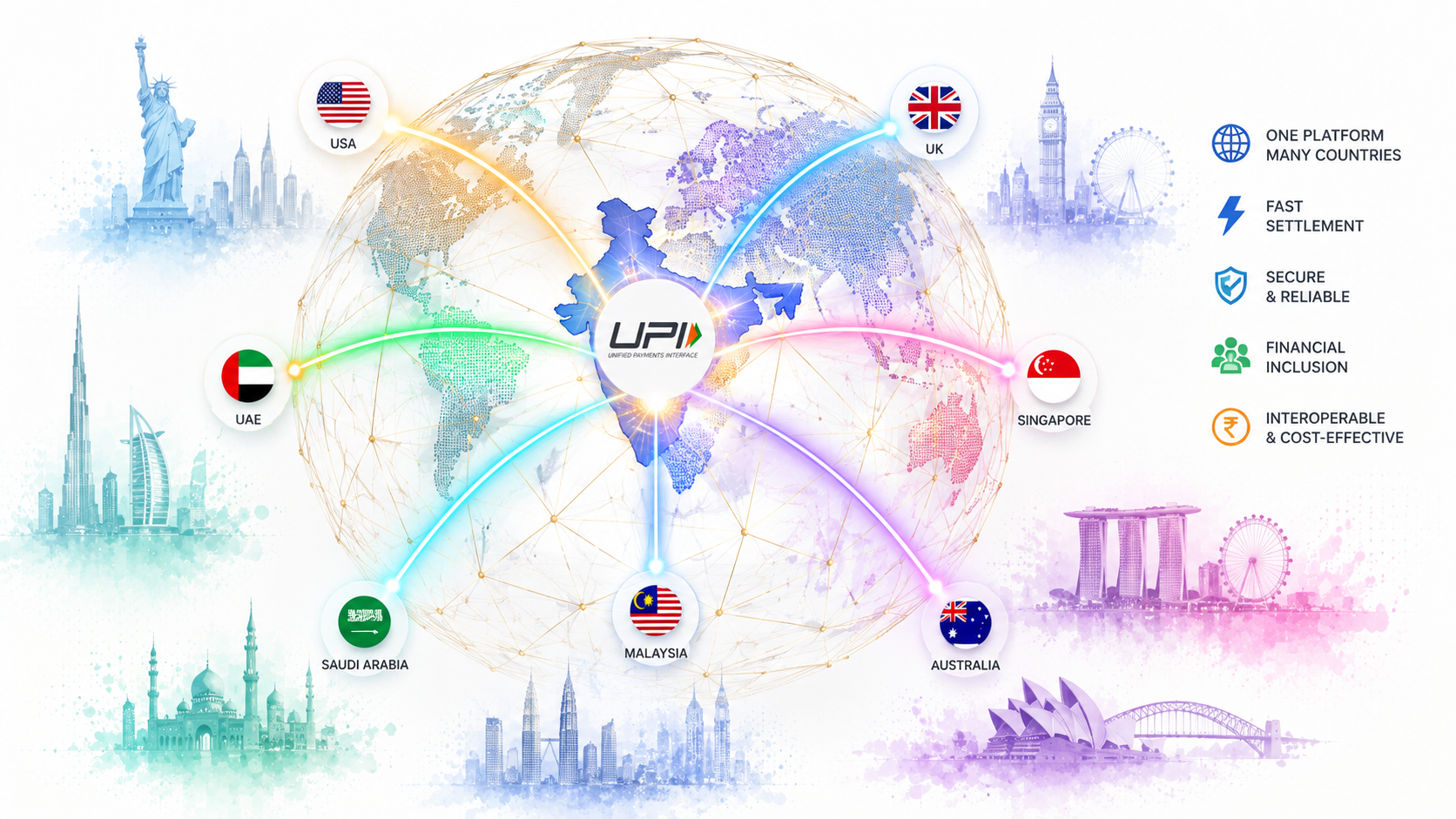
By mid-2026, UPI is live in nine countries — Bhutan, Nepal, Sri Lanka, Singapore, the UAE, France, Mauritius, Qatar and Cambodia — accepted by more than 1.5 million international merchants. The Singapore linkage runs through PayNow, enabling real-time person-to-person remittances between the two countries without the usual correspondent-banking chain. France’s adoption began with UPI acceptance at the Eiffel Tower, a deliberately symbolic entry point into a G7 economy and the eurozone.
The institutional engine behind this expansion is NPCI International Payments Limited, the international arm of India’s National Payments Corporation, which negotiates each country linkage individually — pairing UPI with a partner nation’s own fast-payment system or building direct merchant acceptance from scratch.
Each corridor is a bilateral integration, not a plug into a single global standard the way SWIFT membership works.
That distinction matters for how far the comparison to SWIFT can be pushed. UPI’s real-time settlement and near-zero marginal cost are genuine structural advantages over legacy correspondent banking — there is no argument there. But becoming a global network in the fullest sense would mean UPI, or an interoperable descendant of it, functioning as common infrastructure that many countries transact through with each other, not only with India. What exists today is closer to a hub-and-spoke model, with India at the centre of every spoke. Each new corridor still requires its own regulatory negotiation, foreign-exchange arrangement and partner-country buy-in — slower and more politically contingent than adopting a shared technical standard once.
It is also worth noting where UPI is winning and where it has yet to be tested. Its clearest wins are retail, remittance and travel payments — a tourist paying a merchant, a worker sending money home, a student paying rent abroad. It has not yet demonstrated the same traction in large-value trade finance and wholesale cross-border settlement, the segment SWIFT and correspondent banking still dominate, and where currency convertibility, capital-account rules and counterparty risk management are far more demanding than a QR-code payment at a shop counter.
My assessment: UPI is well on its way to becoming the leading network for retail and remittance cross-border payments in the corridors India cares most about — its neighbourhood, the Gulf, and wherever the Indian diaspora is concentrated. The trajectory of the data supports that claim strongly. Becoming a genuinely global, multilateral payments standard that displaces SWIFT-style infrastructure for trade and wholesale settlement is a different, much larger claim, and nothing in the current evidence suggests UPI is close to that threshold yet.
REFERENCES
IBEF (India Brand Equity Foundation). “Unified Payments Interface (UPI) Goes Global: Cross-Border Transactions Grow 20-Fold in a Year.” August 2025.
Payfuture. “UPI Is Going Global — and Quietly Rewriting the Rules of Cross-Border Payments.” 2026.
RATE THIS ARTICLE