MARKETS & THE FIRM
In 1937, a 27-year-old Ronald Coase asked a question that sounds almost too simple to be worth a Nobel Prize: if markets and prices are such an efficient way to allocate resources, why do firms exist at all? Why doesn’t everyone just contract with everyone else, transaction by transaction, instead of organising themselves inside companies?
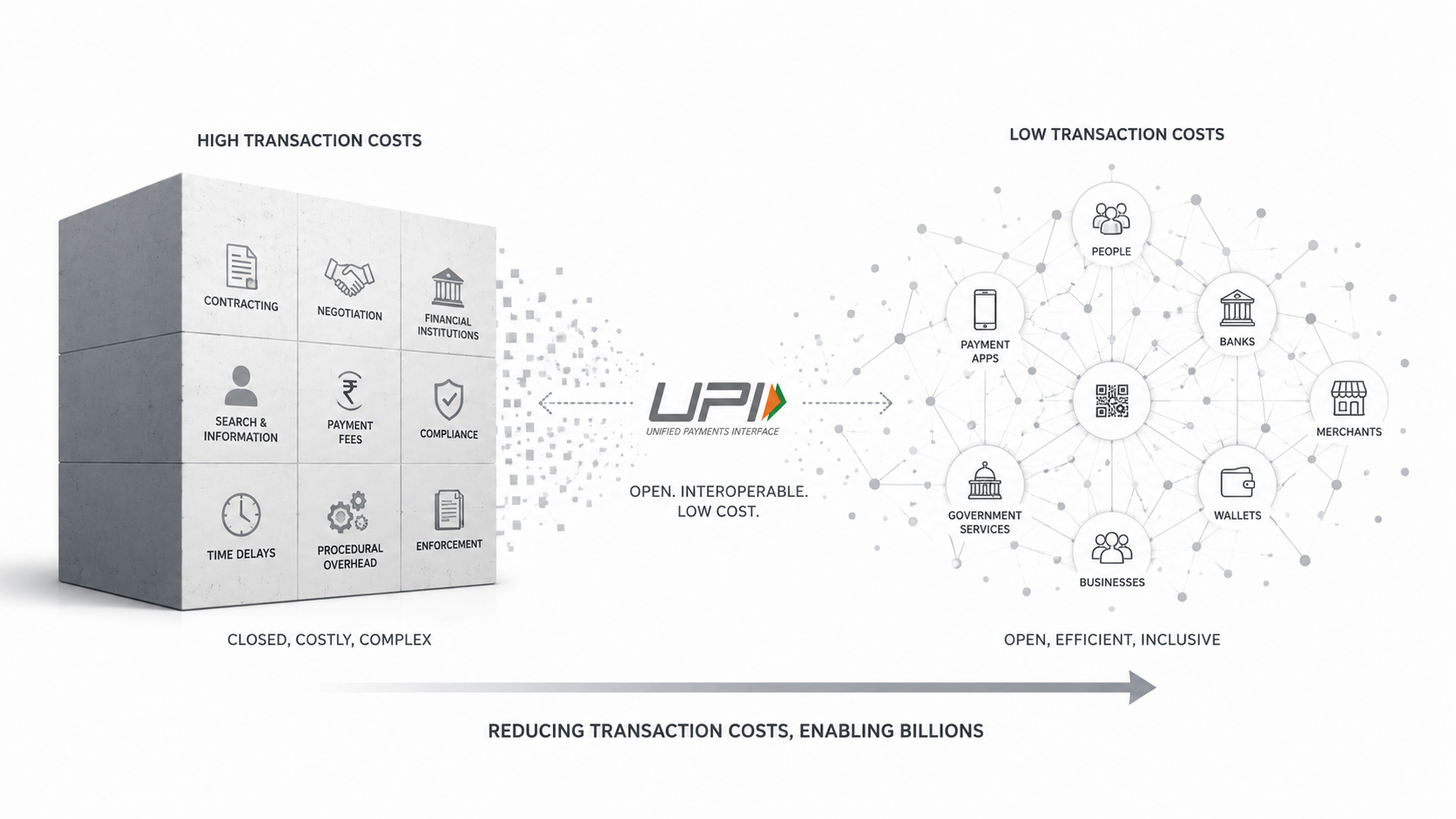
Coase’s answer was transaction costs. Using the market is not free. You have to search for a counterparty, negotiate terms, write a contract, and enforce it if something goes wrong. A firm exists because, for a great many transactions, it is cheaper to bring the activity inside a hierarchy — under one roof, coordinated by a manager — than to negotiate it fresh on the open market every time. A firm, in Coase’s framing, grows until the cost of organising one more transaction internally equals the cost of doing that same transaction externally, through the price mechanism.
UPI is, among other things, a machine for demolishing one specific transaction cost: the cost of moving money between two unrelated parties, instantly, for free, at any hour. In FY 2025-26, UPI processed over 24,000 crore transactions, worth roughly ₹314 lakh crore — a more than 4,000-fold increase in value since its first year of operation.
If a large share of what makes a firm necessary is the cost of arranging payment, monitoring it, and trusting it will settle — and UPI drives that cost toward zero — does that shift Coase’s balance point? At the margin, I think it plausibly does. Consider the sheer number of small-ticket transactions UPI now carries: 86 percent of person-to-merchant UPI payments are below ₹500. A large share of that volume is exactly the kind of micro-transaction that would once have been too costly, in time and friction, to negotiate and settle individually — so it either happened inside a larger, bundled relationship (a shopkeeper’s running tab, a distributor’s monthly settlement) or it simply didn’t happen as a discrete market transaction at all.
It is not breaking the theory, it is confirming it from a new angle.
As the cost of a market transaction falls, more activity should move toward arm’s-length exchange and away from being bundled inside a firm’s internal hierarchy. We can see hints of this in India’s gig and small-vendor economy, where UPI has made it viable for a single driver, delivery partner, or home-based seller to transact directly with thousands of individual customers — a level of atomised, direct market exchange that would have been prohibitively costly to coordinate through cash or cheque.
It is worth being precise about what UPI has and has not done to transaction costs. Coase’s original list includes search costs, bargaining costs, and enforcement costs, not just settlement costs. UPI collapses settlement to nearly zero, but it does very little to reduce the cost of finding a trustworthy counterparty, negotiating quality and price, or enforcing a contract if the other side does not deliver. A firm still exists, in large part, to solve those other problems — which is why UPI has reshaped retail and gig-economy transactions far more visibly than it has reshaped, say, how a manufacturing supply chain organises itself.
My reading, then, is that UPI does not challenge Coase’s theory of the firm so much as it runs a live, population-scale experiment on one variable inside it. Where payment friction was the dominant transaction cost holding an activity inside a firm or an informal, trust-based relationship, UPI has pushed that activity toward the open market. Where the dominant transaction costs are about trust, quality, and enforcement, the firm — and the intermediaries that provide those functions — remains exactly as necessary as Coase said it would.
REFERENCES
Coase, Ronald H. “The Nature of the Firm.” Economica 4, no. 16 (1937): 386–405.
Government of India, Press Information Bureau. “UPI Completes 10 Glorious Years, Emerges as World’s Largest Real-Time Payments Platform, Anchoring India’s Digital Economy.” PIB Delhi, April 2026.
RATE THIS ARTICLE